Start With Gables and Hips
- Metal panels and asphalt shingles both need sound decking, suitable underlayment and flashing that carries water past roof joints.
- A plain gable has fewer junctions to detail than a roof with several dormers, valleys and short slopes.
- Material choice changes the fasteners, repair method and edge details, so compare the complete scope for each roof system.
Gable and Hip Roofs Change the Material Comparison
A straight gable, a hip roof and a roof crowded with dormers require different cuts, joints and drainage details, whichever covering you choose. Start by comparing the whole roof assembly: the visible covering, the wood deck beneath it, underlayment, fasteners and flashing. A material sample alone cannot show how those parts meet at a chimney or rear porch.
A Gable Makes Panel and Shingle Layouts Easier to Compare
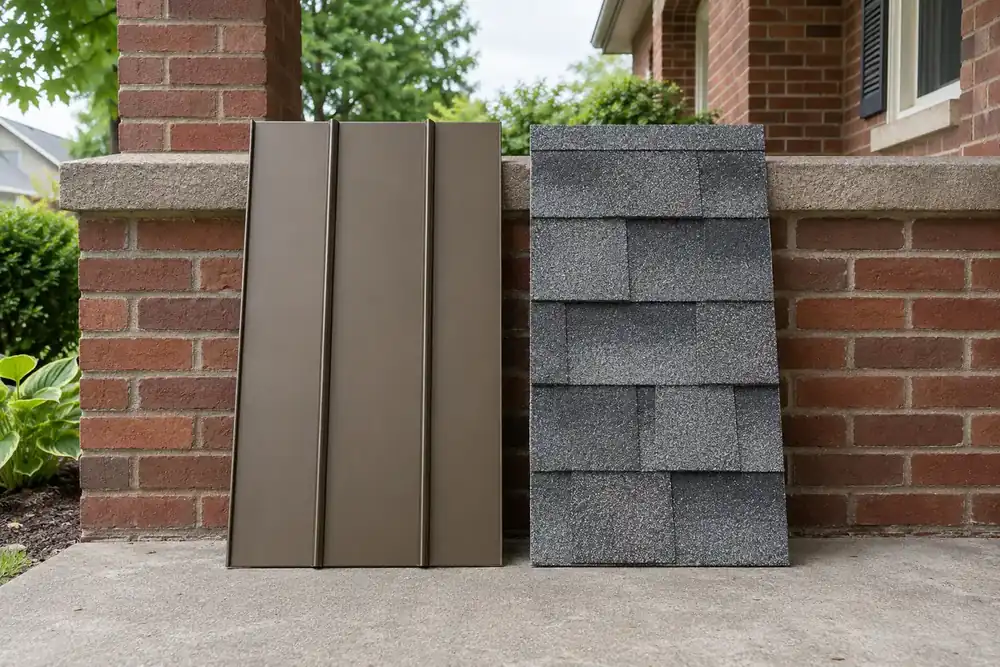
A gable's two main slopes give your roofer a clear starting point for laying out panels or shingle courses. Standing-seam metal uses raised panel joints with concealed attachment along the main seams; exposed-fastener panels have screws visible through their faces. Edge and trim fasteners still need attention on either metal system.
Asphalt shingles overlap in courses and attach with roofing nails. Three-tab shingles have a flatter pattern; architectural shingles use laminated layers for a thicker profile. Underlayment sits between the covering and deck, while flashing handles edges, walls and openings. Ask which panel or shingle product the written scope names.
Hips, Dormers and Valleys Add More Detail Work
A hip roof needs diagonal cuts and caps where the outside slopes meet. Dormers introduce short roof sections and walls; valleys join inward-facing slopes into drainage channels. Panel layout, shingle cuts and flashing all become more involved as those junctions multiply.
| Question | Metal | Asphalt shingles |
|---|---|---|
| What forms the covering? | Standing-seam or exposed-fastener panels | Three-tab or laminated architectural shingles |
| How is it attached? | Clips or screws suited to the panel system | Roofing nails placed for the shingle product |
| What sits underneath? | Underlayment selected for the metal assembly | Underlayment beneath overlapping shingle courses |
| What changes on a hip? | Angled panel cuts and hip trim | Angled shingle cuts and hip caps |
| What changes around a dormer? | Formed wall and roof junction details | Shingle courses integrated with wall flashing |
| How does a repair differ? | A seam, attachment or panel may need attention | Individual shingles and adjoining flashing may need replacement |
| What matters on a low slope? | The panel system's stated slope limits | Whether the slope suits the shingle product at all |
A low-slope rear addition, porch or rowhouse roof needs its own material decision. Your roofer checks the actual pitch and drainage route rather than carrying the main roof's covering across every section. A membrane may belong on a shallow section even when the higher roof uses shingles or metal.
Snow, Ice and Summer Sun Raise Different Concerns
Snow shedding, ice at the eaves and heat absorbed by the surface are separate parts of the material decision. Snow, ice and sun exposure make eave drainage, surface finish and the layers beneath the covering part of the comparison.
Ask your roofer how snow and ice shed from metal compared with shingles and about protection above doors, walkways and lower roofs. Melting and refreezing can also trap water at cold eaves, so attic heat loss deserves attention alongside the covering.
Summer heat depends partly on the finish: ENERGY STAR explains that reflective roofing surfaces absorb less sunlight. Compare the actual coating or shingle product. Dark streaks on shingles may be algae, as described by University of Georgia Extension, and need a different assessment from a split shingle. On metal, rust around a fastener merits inspection; ask your roofer whether the exposed fasteners suit the surrounding panel.
Rain noise depends on the assembly beneath the covering, too. Discuss the deck, insulation and ceiling arrangement rather than judging an occupied house by the sound of a bare metal shed.
What Decides How Long a Metal Roof Lasts
A metal roof's life depends on the product, attachment details, exposure and maintenance. A corroded attachment or leaking chimney joint needs attention even when the panels look sound.
Is Metal Roofing Better Than Shingles on Gable and Hip Roofs?
Neither material is the better choice for every roof type. A simple gable offers long panel runs; many small dormers introduce more cuts and formed details. Shingles divide the covering into smaller pieces, but the wall and valley work still matters. Your roofer should explain how a repair would reach the failed part without disturbing sound areas unnecessarily.
What to Compare When Pricing Metal Against Shingles
The less costly option depends on the metal system, shingle product and work included. Pitch, access, existing layers and decking condition also affect the comparison. Comparing metal roofing cost vs shingles means including equivalent tear-off, underlayment and flashing work. A comparison of metal roofing cost vs asphalt shingle replacement also needs the chosen panel system and shingle type stated clearly.
What Drives Metal Roofing Cost Next to Shingles
The difference comes from the specified materials and the labor needed for your roof's geometry. One of our local roofing companies will explain the selected system, access needs and decking assumptions, then walk through the price before work begins. The roof replacement cost page breaks down those scope factors. Stay off the roof and ladders; photos taken from the yard or a safe indoor position can help you describe the affected section during the call.