Flashing Keeps Water Moving
- Roof flashing is shaped material, usually metal, that directs water past roof joints, edges and openings.
- Step pieces, chimney counterflashing, valley metal and pipe boots protect different connections, so each belongs in the roof assessment.
- Flashing must join the surrounding roof layers correctly; a surface bead alone does not explain how water will drain.
Roof Joints Need Their Own Drainage Details
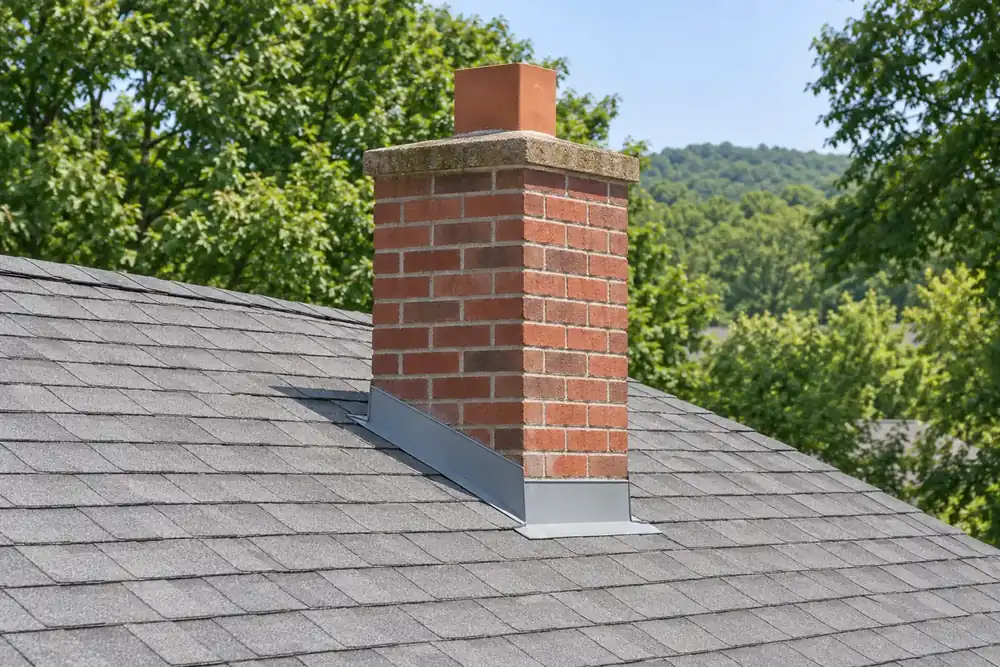
Roof flashing directs water across interruptions in the roof covering, including walls, chimneys, valleys and pipe openings. A gable's broad shingle field sheds water through overlapping courses; a wall or chimney breaks that pattern. Flashing gives the water a route around the break and back onto a surface that drains outside.
What Is the Purpose of Flashing on a Roof?
The purpose of roof flashing is to keep runoff moving past joints without entering the roof or wall beneath them. PNNL's roof-penetration guidance identifies openings as weak points in the roof's water-control layer. Those connections deserve close attention when a ceiling stain appears below a chimney, dormer or vent, even if the middle of the slope looks intact.
Which Materials Are Used for Roof Flashing?
Roof flashing is commonly formed from galvanized steel, aluminum or copper. Pipe boots may combine a base flange with a flexible collar. The chosen material has to suit the roof covering and the surfaces it touches; matching color alone is not enough.
Gables and Hips Have Different Edges and Openings
Gable and hip roofs both need drainage details at their edges and around anything passing through a slope. A chimney needs several connected pieces, while a pipe needs a collar fitted to the opening. The following table separates six locations so a scope can name the actual part.
| Where it goes | What it is | Why it matters |
|---|---|---|
| Along a dormer or sidewall | Step flashing interwoven with shingle courses | Directs water from the wall joint onto the roof |
| Around a chimney above base flashing | Counterflashing overlapping the lower pieces | Protects their upper edges at the masonry |
| Where inward slopes meet | Metal lining in an open valley | Carries runoff from both slopes downhill |
| Around a vent pipe | A collar or boot joined to a base flange | Protects the opening around the pipe |
| Along the eave | A formed metal drip edge | Guides runoff away from the deck edge |
| Around a skylight | A flashing kit matched to the unit and roof | Connects the skylight perimeter to the surrounding covering |
For skylights, flashing selection depends on roof pitch and covering. A kit suited to a steep shingle slope is not automatically the right detail for a shallow porch roof.
Dormers and Chimneys Need Overlapping Connections
Shingled dormer walls use step flashing that overlaps with successive shingle courses, while chimney counterflashing covers the upper edges of the lower flashing. PNNL describes overlapping step pieces and separate continuous details for metal or membrane roofs. Your roofer checks how the roof, wall covering and flashing connect, including hidden edges that a ground-level photograph cannot show.
A low-slope addition asks a different question: how does its membrane turn up the wall, and where does the water leave? The roof layout and drainage route determine the junction detail. Flashing repair on a roof should address that whole connection.
Underlayment Sits Beneath the Shingles
Underlayment is the sheet layer between shingles and the roof deck, often felt or a synthetic material. PNNL places underlayment within the roof's water-control assembly. Flashing has to connect with that layer so water reaching a joint can drain outward. Replacing the visible metal without checking the concealed overlap can leave the original entry path unresolved.
What Is Roof Flashing Repair?
Roof flashing repair restores the failed junction by correcting or replacing damaged pieces and their connections to nearby materials. To repair flashing on a roof, your roofer may need access beneath adjacent shingles or wall covering. Ask which surrounding materials will be removed and restored, rather than treating every flashing problem as an exposed gap.
Should Flashing Be Replaced With a New Roof?
Roof-wall flashing should be renewed as part of replacement work, and other flashing needs a condition and compatibility assessment, following PNNL's guidance for existing roof-wall intersections. The written scope should identify each location, material, adjoining repair and underlayment connection.
Roof pipe boot replacement cost depends on the boot type, pipe fit, access and condition of the surrounding covering. One of our local roofing companies will describe the affected junctions and explain how those details affect the price before the work starts.
Read the Signs From Solid Ground
Rust streaks, displaced metal, visible sealant gaps and a stain below a chimney are reasons to call for an assessment, not enough evidence to name the failed part. Stay on the ground and off ladders; leave roof access and resealing to your roofer. Photos from a clear indoor spot or the yard can help locate the concern.
If water drips indoors, move belongings and place a bucket beneath the drip where safe. Keep away from a ceiling that sags or bulges. Leave a light switch off when water is near the fixture, and avoid touching the fixture or wiring. Describe the location during the call for roof leak repair.